Published on
August 12, 2026
AI Strategy for RIA & Family Office Operations: MCP Servers, Open Architectures for Owning your data, Owning your reporting, Owning your IP — without vendor lock-in!
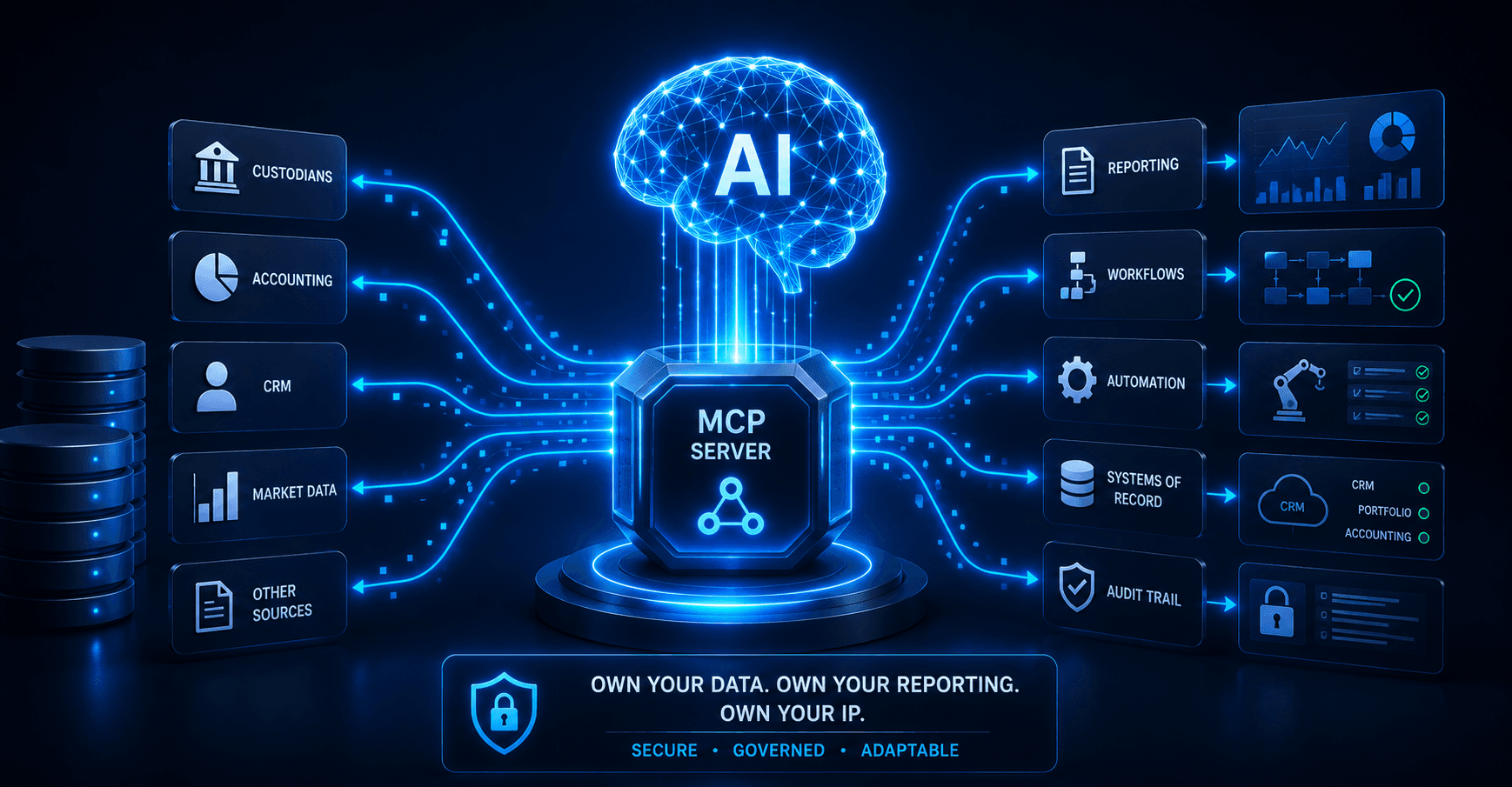
AI in wealth management is often presented as a question of automation. A more fundamental question is:
Who owns the data, reporting capability and operational knowledge created through the use of AI?
For RIAs and family offices, the strategic opportunity is not simply to adopt another AI tool. It is to build an operating architecture that is controlled by the firm, remains adaptable and reduces unnecessary dependence on proprietary platforms.
Own your data
An ownership-oriented strategy begins with the data environment.
A firm-controlled data lake can consolidate information from custodians, accounting systems, CRMs and other sources within the firm's own cloud environment.
The key principles are:
- The firm controls administration and access.
- Data can be analysed within its own environment.
- Client and entity data remains strictly separated.
- Reporting is based on a governed source of truth.
- Data does not need to be copied into multiple third-party platforms.
This approach does not eliminate the need for security, access controls, monitoring or regulatory oversight. It does provide the firm with greater control over how those requirements are implemented.
Open architectures and MCP Servers
An open architecture also needs to interact with the systems that remain part of the operating environment.
An MCP Server can act as an orchestration layer between an AI model, the firm's data environment, APIs and systems of record.
It can help to:
- Retrieve information from several systems.
- Apply defined validation and workflow rules.
- Combine data for reporting and analysis.
- Trigger approved operational processes.
- Write validated information back into systems such as a CRM.
- Maintain an audit trail of the activity.
The objective is not necessarily to replace existing systems. It is to coordinate them while allowing those systems of record to remain authoritative and up to date.
Design with AI, execute with code
AI is useful for designing and improving workflows. It can help identify data sources, suggest validation rules, map exceptions and generate an initial implementation.
However, repetitive production processes require consistency and auditability.
A useful operating principle is:
- AI designs the workflow.
- Code executes the workflow.
- Controls validate the result.
- An audit trail records the activity.
This approach combines the flexibility of AI with the reliability required for daily operations.
Own your operational IP
Every operational workflow contains firm-specific knowledge:
- Validation rules.
- Approval thresholds.
- Exception handling.
- Escalation procedures.
- Reporting logic.
- Entity-specific requirements.
When this knowledge is documented and captured in reusable workflow specifications or skills documents, it becomes operational intellectual property.
Over time, firms can build a library of processes that reflects how they actually operate. This knowledge is potentially more durable than any individual software platform or AI model.
Avoidable mistakes
AI strategies often underperform for four reasons:
- AI is used to execute repetitive tasks directly, without sufficient controls.
- Data is copied into another platform unnecessarily.
- Attention is focused on dashboards rather than validation, exceptions and audit trails.
- The platform is treated as the asset instead of the process design.
The practical principle is simple:
Design with AI; run reliably on code.
A practical starting point
Firms do not need to begin with a large transformation programme.
A practical sequence is:
- Establish a governed source of truth in the firm's own cloud environment.
- Select one high-value reporting or operational workflow.
- Design it with AI and implement it using deterministic code.
- Connect it to existing systems through controlled integrations.
- Capture the workflow and its controls as reusable IP.
- Extend the same pattern to additional processes.
The important question is not whether an RIA or family office uses AI.
It is whether the firm is building capabilities it owns — including the data, the reporting, the workflows and the knowledge accumulated through operating them.
I work with financial institutions on technology integration and data aggregation (including API/SDK solutions at Collation.AI). Happy to connect and discuss your firm's technology strategy.