Published on
July 15, 2026
AI in Wealth Management: From Convenience Theatre to Operational Discipline
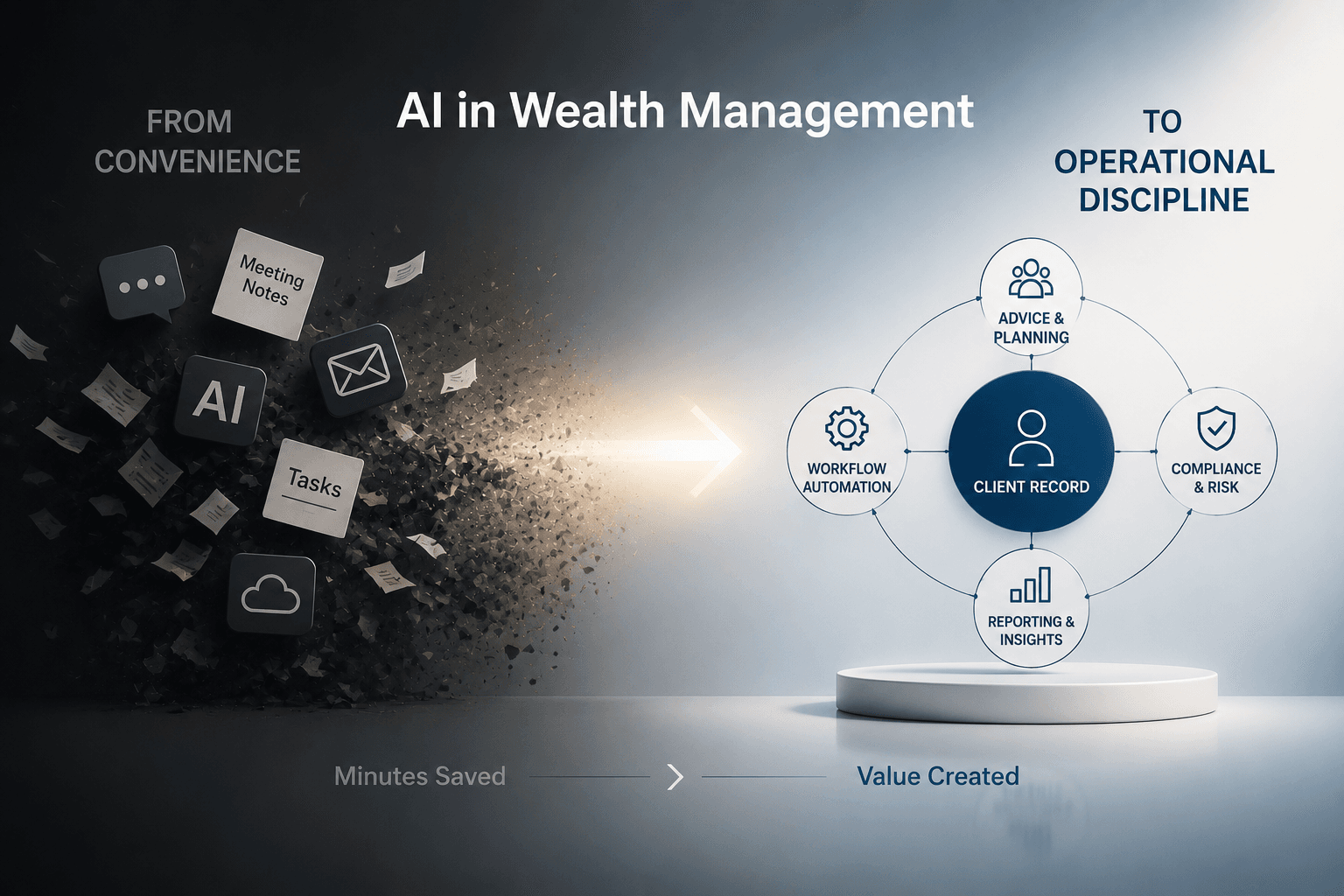
Wealth firms are investing heavily in AI, but much of that spend still targets convenience rather than how the firm actually runs. Meeting notetakers, call summarizers and task extractors are useful, yet they often sit outside core workflows, delivering little real operational or compliance value.
The risk: we celebrate "time saved per advisor" while the operating model remains unchanged.
The Convenience Trap
Most AI tools today live at the interaction level: this meeting, this email, this task. Success is measured in minutes saved, not in the quality of client records or the reliability of processes.
That creates a trap:
- AI outputs land in inboxes, shared drives or separate apps.
- Some data reaches the CRM, some is copied to planning tools, some is never integrated.
- Information fragments, supervision gets harder, and audit trails weaken.
On the surface, work feels easier. Underneath, the firm has paid for more data it cannot consistently use.
Interaction AI vs. Operational AI
Wealth management doesn't run on isolated interactions; it runs on workflows: onboarding, advice delivery, reviews, suitability checks, and ongoing monitoring.
"Interaction AI" helps with:
- Summarising meetings.
- Drafting emails.
- Extracting tasks.
"Operational AI" helps with:
- Enriching the client record as a single source of truth.
- Driving actions through defined workflows across teams.
- Supporting compliance, risk and audit with consistent, accessible data.
Until AI is tied to workflows and the client record, it's a helper, not a capability.
What Operational AI Should Look Like
A more disciplined view of AI in wealth management focuses on four elements:
1. Client record first
AI captures and structures information to strengthen the client narrative over time, not just describe a single meeting.
2. Workflow integration
Notes, tasks and signals flow automatically into existing processes: reviews, follow-ups, approvals, and checks.
3. Cross-team value
Advisors, operations and compliance can all see and act on AI-enriched data in a consistent way.
4. Governed and auditable
AI outputs are treated as part of the firm's data estate, with clear ownership, standards and controls.
When these elements are present, AI stops being a convenience layer and becomes part of how the firm operates.
Better Questions for Leaders
Rather than asking "Which AI tool should we buy?", leaders can start with different questions:
- Which specific workflow are we trying to improve?
- How will AI outputs reach our core systems and client records?
- Who owns the quality and use of that data once it's created?
- How will we demonstrate that AI strengthens, rather than bypasses, our governance?
These questions move the discussion from demos to outcomes.
From Theatre to Discipline
AI will amplify whatever operating model is already there. If processes are strong, AI can make them faster and more transparent. If processes are weak, AI will scale inconsistency and risk.
For wealth firms, the opportunity is clear: use AI not to create a theatre of convenience, but to build operational discipline around the client relationship. The winners will be those who treat AI as an instrument of structured workflow and governance, not just a smart notetaker on top of legacy processes.
I work with financial institutions on technology integration and data aggregation (including API/SDK solutions at Collation.AI). Happy to connect and discuss your firm's technology strategy.