Published on
June 24, 2026
The Hidden Costs of AI Projects
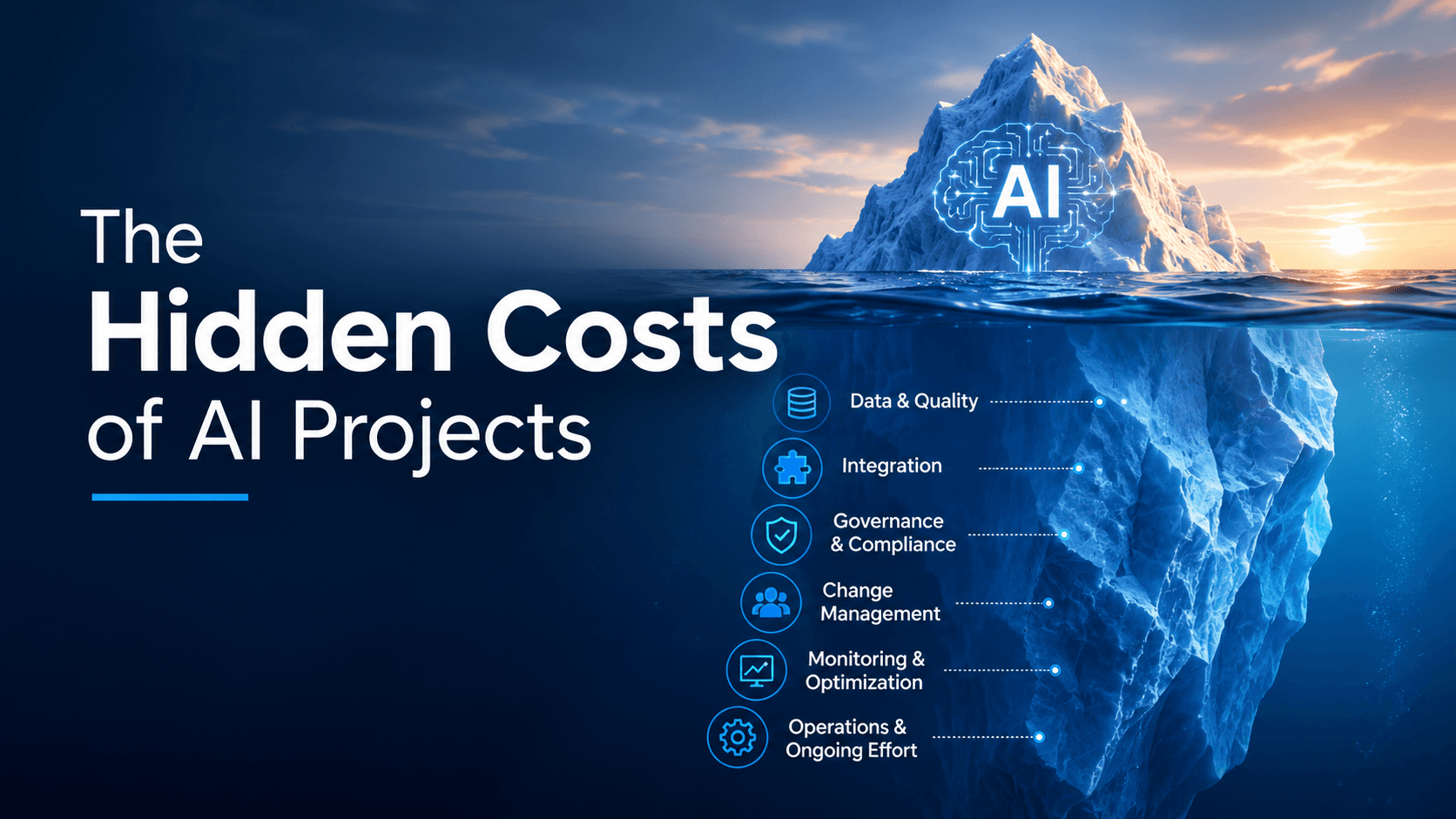
AI projects rarely fail because the model "doesn't work." They fail because teams underestimate the full system required to make AI useful at scale.
The real budget is not the API call. The real budget includes data readiness, integration, governance, change management, monitoring, and the operational discipline needed to keep the solution relevant over time.
Executive summary
Most organizations still evaluate AI as if it were a software purchase. In practice, AI is an operating model change.
The visible costs are easy to approve. The invisible costs are the ones that quietly compound and determine whether the initiative becomes a business asset or another pilot that never scales.
The cost mistake
The most common mistake is to price AI around the tool and ignore the environment around it. That is like buying a high-performance engine and forgetting the chassis, fuel system, and maintenance plan.
Teams often focus on licensing, then discover the larger line items later: data cleanup, system integration, security review, process redesign, training, and ongoing model oversight.
Where budgets expand
A realistic AI budget should account for several categories that are frequently missed in early planning:
- Data preparation and quality work.
- Integration with legacy systems and workflows.
- Governance, compliance, and risk controls.
- Change management and staff training.
- Monitoring, tuning, and retraining after launch.
- Internal time spent aligning stakeholders and redesigning processes.
This is why many AI business cases look elegant on paper but fragile in practice. The project is not just a model deployment; it is a change to how the organization creates, moves, and trusts information.
The data foundation
AI does not eliminate weak data foundations; it exposes them faster. If the data layer is fragmented, inconsistent, or hard to govern, the project inherits those weaknesses immediately.
That is why the conversation should move beyond "Do we have a model?" to "Do we have a usable data foundation?" In many organizations, a governed lakehouse becomes the more strategic answer because it supports analytics and AI on a single foundation rather than forcing constant data duplication.
The governance gap
Governance is another hidden cost that is easy to postpone and expensive to retrofit. As AI usage expands, organizations need clear accountability, review processes, policy updates, and guardrails for risk.
This matters because AI systems are not static. Models change, data changes, regulations change, and business expectations change. Without a governance model, the project accumulates friction every time it needs to evolve.
The change problem
The hardest part of AI is often not technical. It is organizational.
People need training, new workflows, clear ownership, and a reason to trust the output. If those elements are missing, adoption slows and the expected ROI evaporates even when the underlying tool is strong.
A better lens
The right question is not "How cheap is this AI tool?" The better question is "What does it cost to make this AI capability reliable, governable, and scalable?"
That shift in thinking changes everything. It forces leaders to treat AI as a portfolio of capabilities, not a one-line subscription expense.
Final thought
AI will reward organizations that build the boring foundations well: clean data, clear process ownership, thoughtful governance, and realistic expectations. The companies that get this right will not just deploy AI; they will operationalize it.
And in many cases, the difference between a successful program and an expensive experiment will come down to whether the organization invested in the underlying data architecture first — including whether a lakehouse was treated as a strategic foundation rather than a buzzword.
I work with financial institutions on technology integration and data aggregation (including API/SDK solutions at Collation.AI). Happy to connect and discuss your firm's technology strategy.