Published on
July 2, 2026
How AI Will Impact RIA Valuations (In Practice, Not Theory)
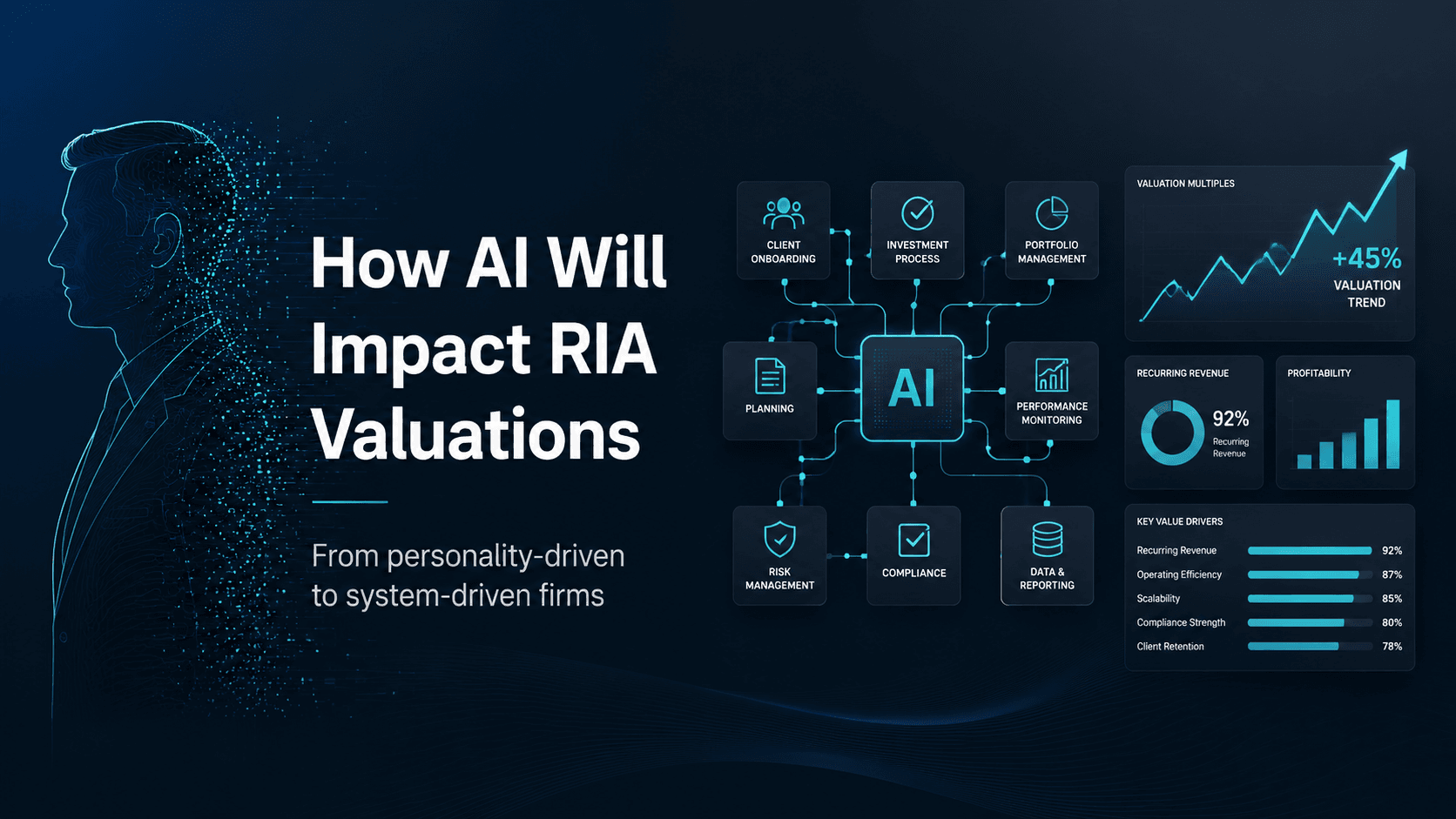
Most RIA conversations about AI still focus on tools: better note-taking, smarter CRMs, automated marketing. Useful, but from a valuation perspective, they are symptoms, not the story.
The real impact of AI on RIA valuations comes down to one question buyers and investors are already asking:
"Is this a personality-driven business, or a system-driven one?"
AI is what helps you move from the former to the latter. It captures knowledge, standardizes workflows, and turns client engagement into something that can survive advisor turnover and ownership changes. That's what shows up in how a firm is priced.
Margin: Turning Efficiency Into Enterprise Value
Most RIAs still carry a lot of manual, repeatable work: meeting prep, document handling, data entry, follow-ups. When AI absorbs those tasks, the impact isn't just "time savings"—it's structure:
- Fewer non-advisory roles per unit of AUM
- Higher revenue per employee
- More operating leverage as you grow
Two firms with similar AUM and revenue can therefore justify very different EBITDA and, ultimately, different valuation multiples. The one that can demonstrate AI-enabled efficiency at scale is going to look more attractive in any M&A process.
Growth: From Opportunistic To Repeatable
Organic growth in RIAs has traditionally been driven by individual advisor effort, a few strong years in markets, and opportunistic wins. Hard to model, hard to transfer.
AI changes that by turning data into a repeatable growth engine:
- Prioritized outreach based on behavior and life events
- Systematic identification of cross-sell and upsell opportunities
- Better segmentation of clients and prospects by need and potential
When this is embedded into weekly routines and dashboards, buyers are no longer underwriting "hope." They see a process for generating future revenue, not just a history of good years.
Risk: Seeing Retention Instead Of Assuming It
Client retention is one of the biggest variables in any RIA deal, and historically one of the hardest to quantify. AI gives you better visibility into:
- Early signals of churn based on flows and engagement
- Single-threaded relationships that are fragile post-transaction
- Where intervention is needed to protect key households
If you can show that you're not only tracking these risks but actively managing them, the perceived volatility of your book goes down—and with it, the discount buyers apply to headline AUM and revenue.
What This Means For Valuation Conversations
Put simply, AI shifts the discussion from "What tools do you use?" to "How does your business run?" In valuation terms, buyers and investors will increasingly reward firms that can demonstrate:
- Higher, more defensible margins
- More repeatable organic growth
- Better visibility and control over client retention
That's the profile of a system-driven, AI-enabled RIA—one that deserves to sit at the upper end of the multiple range when M&A or recapitalization comes into play.
Closing Call-To-Action
If you advise RIAs on M&A, succession, or strategic planning, AI readiness needs to be part of your standard playbook. The question is no longer whether your clients are "using AI," but whether AI is improving the levers that actually drive enterprise value.
A simple AI readiness checklist for RIA consultants might include:
- Margin: Can the firm point to specific workflows where AI has reduced manual work and changed the cost structure—not just saved "time"?
- Growth: Is there a documented process for using data and AI to prioritize outreach, identify opportunities, and track conversion, beyond individual advisor initiative?
- Risk: Does the firm monitor churn risk and relationship fragility with more than anecdotes—and act on those signals?
- Documentation: Are AI-enabled workflows captured in playbooks and systems so they survive advisor transitions and ownership change?
- Narrative: Can leadership clearly articulate how AI fits into the firm's operating model and how that translates into a more valuable, more resilient business?
The consultants and RIAs that start answering these questions now will be the ones shaping, not reacting to, how AI is priced into RIA valuations over the next cycle.
I work with financial institutions on technology integration and data aggregation (including API/SDK solutions at Collation.AI). Happy to connect and discuss your firm's technology strategy.