Published on
October 7, 2026
Vendor Lock-In and the Single Pane of Glass Problem
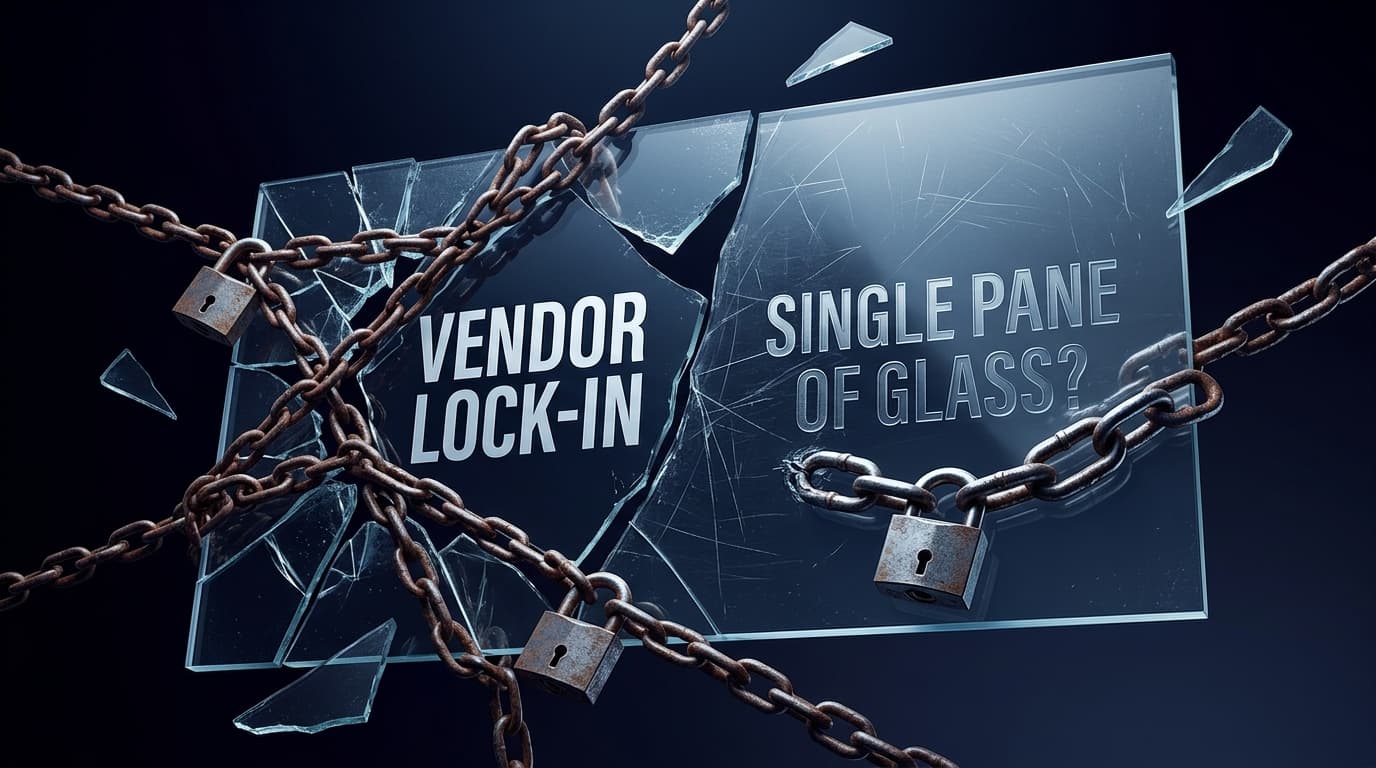
The "single pane of glass" has become one of the most attractive ideas in wealth management.
One screen.
One view.
One place to see the client, the household, the portfolio, the documents, and the outstanding actions.
It sounds like the answer to fragmented operations.
But there is a question that deserves more attention:
Does a single pane of glass reduce complexity — or simply move the dependency into one vendor's platform?
The problem it is meant to solve
Family offices, RIAs, and wealth-management firms rarely operate from one system.
Their information is distributed across:
- General ledgers.
- Portfolio accounting platforms.
- Custodians.
- CRM systems.
- Financial-planning tools.
- Alternative-investment databases.
- SharePoint and document repositories.
- Email.
- Spreadsheets.
- Bespoke internal databases.
Each system may perform its own function well.
The problem starts when someone needs to answer a question that crosses several of them:
- What is the complete position of this household?
- Which entities own the underlying assets?
- Has the latest custodian activity been booked?
- Is the investment policy statement on file?
- Which documents are approaching expiry?
- What changed since the previous report?
- Which client-service tasks remain outstanding?
- Can the information be explained consistently to the family or investment committee?
The answer usually requires manual searching, reconciliation, copying, and interpretation.
That is not just a reporting issue.
It is an operating-model issue.
A single screen is not a single source of truth
A visually attractive dashboard can still rely on:
- Duplicated data.
- Conflicting definitions.
- Stale records.
- Missing accounts.
- Unclear ownership.
- Manual spreadsheet adjustments.
- Incomplete document indexing.
- Unreconciled feeds.
The result may look unified while the underlying information remains fragmented.
This is the important distinction:
A single pane of glass is an interface. A governed data layer is infrastructure.
One shows information.
The other determines whether the information can be trusted.
Where vendor lock-in begins
Many vendors position their platform as the complete answer:
- The data warehouse.
- The dashboards.
- The workflow engine.
- The AI assistant.
- The integrations.
- The controls.
- The reporting logic.
The convenience is obvious.
But the long-term dependency may be less obvious.
Over time, a firm may discover that:
- The data lives in the vendor's environment.
- The data model is not fully documented.
- Reports cannot be exported cleanly.
- Integrations depend on proprietary connectors.
- Workflow logic is trapped in configuration.
- AI controls sit inside the vendor's platform.
- Switching providers would mean rebuilding the operating model.
- The firm cannot easily separate its own data from the vendor's intellectual property.
At that point, the "single pane of glass" may have become a single point of dependency.
The strategic mistake
The mistake is not using a platform.
The mistake is confusing a platform with ownership.
A family office or RIA does not need to build every component itself.
But it should distinguish between:
- Using a vendor's software.
- Renting a vendor's operating model.
- Building a capability the firm can control and evolve.
These are not the same thing.
The real question is:
If the vendor disappeared, could the firm continue operating its reporting, workflows, and data processes?
If the answer is no, the firm may have purchased convenience at the cost of strategic independence.
What the firm should own
The most important assets are not necessarily the dashboards.
They are the things that accumulate over time:
- The data.
- The data definitions.
- The household and entity structure.
- The permissions model.
- The reconciliation rules.
- The reporting logic.
- The workflow design.
- The exception-handling rules.
- The audit trail.
- The operating procedures.
- The firm's accumulated institutional knowledge.
The platform may change.
The model provider may change.
The firm's knowledge should not disappear with either of them.
The better architecture
The strongest approach may not be:
"Replace every system with one platform."
It may be:
Keep authoritative systems in place, add a governed data layer across them, and build reporting and orchestration on top.
That means:
- Custodians remain authoritative for custody data.
- Accounting systems remain authoritative for accounting records.
- CRMs remain authoritative for relationship data.
- Portfolio systems remain authoritative for investment records.
- Documents remain controlled in their appropriate repositories.
- The firm owns the layer that reconciles, organizes, reports on, and acts across them.
The single pane of glass then becomes an overlay across the operating environment.
It does not need to replace every system.
It does not need to force the firm into one vendor's ecosystem.
Where AI fits
AI can make this architecture significantly easier to design and operate.
It can help teams:
- Map data sources.
- Generate transformation logic.
- Create reports from plain-language instructions.
- Summarize documents.
- Identify missing information.
- Explain changes between reporting periods.
- Draft workflow definitions.
- Generate integration code.
- Surface exceptions for human review.
But there is an important discipline:
Use AI to design and accelerate the workflow. Use deterministic code and governed processes to run it reliably.
A language model may be excellent at proposing how a workflow should work.
It should not necessarily be trusted to perform a critical recurring process differently every morning.
Production workflows need:
- Repeatability.
- Auditability.
- Version control.
- Predictable outputs.
- Clear exception handling.
- Portable logic.
AI should shorten the path from idea to working process.
It should not turn the process into a black box.
Questions to ask before buying
Before adopting a "single pane of glass," firms should ask:
Data ownership
- Where does the data live?
- Who controls the cloud account?
- Can the firm access and export the raw data?
- Is the data model documented?
- What happens to the data if the contract ends?
Integration architecture
- Does the platform replicate data or virtualize access?
- Are stable SQL, ODBC, or JDBC endpoints available?
- Are external BI tools genuinely supported?
- Can the platform write back to existing systems of record?
- Are the connectors portable or proprietary?
Reporting and workflows
- Can the firm create and modify reports independently?
- Can reports be distributed programmatically?
- Are household and entity structures supported?
- Can historical versions be compared?
- Can the firm retain its reporting logic outside the platform?
- Can workflows be exported, version-controlled, and reused elsewhere?
AI and governance
- Can AI search structured and semi-structured information?
- Are data sources and citations visible?
- Can sensitive documents or households be excluded?
- Who controls the prompts, permissions, and policies?
- Are model versions and workflow changes recorded?
- Can the firm change AI providers without rebuilding the operating layer?
Commercial independence
- Are pricing and usage limits transparent?
- Are there per-user, storage, or API fees?
- What functionality becomes unavailable if the contract ends?
- Can the firm continue operating its workflows independently?
- Does the contract preserve the firm's ownership of data, reporting, and process design?
The controversial conclusion
The best single pane of glass may not be the most polished one.
It may be the one that:
- Uses the firm's own governed data.
- Keeps systems of record authoritative.
- Makes reporting logic portable.
- Exposes data lineage.
- Supports open integration standards.
- Allows AI providers to be changed.
- Preserves the firm's workflows as intellectual property.
- Does not turn the vendor into the gatekeeper of the operating model.
A dashboard can make a firm look connected.
Ownership is what makes it resilient.
The real danger is not having too many systems.
It is replacing many visible dependencies with one invisible dependency.
The takeaway
A single pane of glass should reduce operational friction without creating strategic captivity.
The right architecture gives the firm:
- One governed view.
- Multiple authoritative systems.
- Portable workflows.
- Transparent controls.
- Reliable data.
- Replaceable models.
- An audit trail the firm can actually access.
The goal is not to eliminate every vendor.
The goal is to ensure that no vendor owns the firm's ability to understand and operate its own business.